Tampilkan postingan dengan label Indonesian primitive art. Tampilkan semua postingan

Kamis, 12 Juni 2014

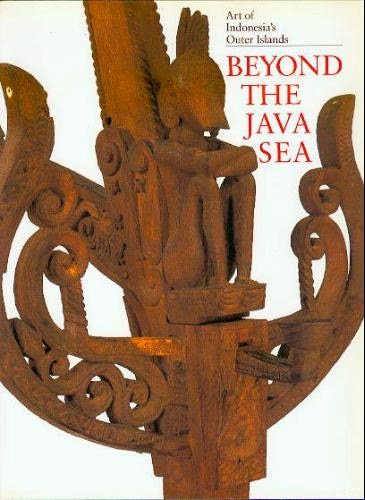
Beyond the Java Sea (rare book)


Beyond the Java Sea

SOLD

Contact: 0818182628 (HP)
E-mail: mulia.santoso@gmail.com
BB: 79FA52CA

Softcover, 11.75" x 8.75", 318 pages, 11 maps, References, Over 350 items, figures and field photos in color and b/w. Text by Paul Michael Taylor and Lorraine V. Aragon. Published by The National Museum Of Natural History, Smithsonian Institution in association with Harry Abrams, New York, 1991.

A splendid book with a superb selection of objects and illuminating field photos. There are chapters on The Indonesian Archipelago and its art, Traditional Indonesian Aesthetics and Design, Nias, Batak, Lampung, Dayak, Sulawesi, Lesser Sunda Islands, Southest Moluccasa, and the North Coast Of Irian Jaya. The text is very readable and highly informative. Items featured include figures, costumes, weapons, jewelry, panels, doors, effigies, drums, canoe prows, fabrics, ornamental objects, shields, and masks. One of the best books available on island Indonesian tribal art!

Kamis, 13 Februari 2014

Upuinai tavu from Tanimbar island


Upuinai Tavu from Tanimbar

SOLD.

Contact: 0818182628 (HP)
E-mail: mulia.santoso@gmail.com
BB:79FA52CA

The fertility statue "upuinai' is a deity statue of the earth/moon. Fertility statues are female statues in the form of a "tree of life" and than carved in such a way until it has an anthropomorphic form, where the whole surface is covered by carvings of the symbol of fertility. Both arms stretched to the left and right and the tips of her fingers are flames of fire. Included in this classification are also the fertility carvings. Very fine and beautiful spiral carvings carved on a flat wooden surface.

Senin, 13 Januari 2014

Upulera statue from Leti island


Sample application in the interior (right side)

Upulera statue from Leti island


SOLD.
Contact: 0818182628 (HP).
E-mail: mulia.santoso@gmail.com
BB:79FA52CA

A deity statue which has an anthropomorphic form, being in a sitting position and the knees are bent reaching his chest and both arms resting on the knees. As with all Leti male ancestors, it squats on its pillar with arms clasped around its knees. This statue is placed on a carved wooden pole and represents one of the first leaders of a clan or community.  Its ornate earrings and headdress indicate its high rank, and possibly its identity. The motifs carved on the plinth and ear lobes represent ancestors’ names or events in the history of the clan that once owned the statue.
On the top of the pole, extended to the left and right, are two wings (or a boat symbol). There are two wings, one bigger than the other, probably this symbolizes a vertical-down relationship to dere and luli (the founding fathers) and a vertical-up relationship with "it matromna" (the creator of the universe). The wings wriggles like flames of fire (symbol of divine power). This statue is a personification of the sun god (Upulera). Upulera statues are always on poles because of it's high status.
Storytellers used these motifs to help them memorize their clan stories. The motifs may have been purely decorative, but if they were of a special type called rou, they would have been the exclusive property of the clan. Only that clan could understand the meaning of these rou motifs.